


Have you ever completed a training session feeling confident, only to forget most of it a week later? Unfortunately, that happens all the time.
Forgetting is a natural part of how the brain works. But when learning programs fail to stick, it’s often not because learners aren’t motivated but rather because the training wasn’t designed with memory science in mind.
Understanding the science behind learning and memory used to be an academic exercise only. But corporate L&D teams, HR leaders, and instructional designers realized that such comprehension meant competitive advantage.
You see, when learning experiences align with how the brain actually processes, stores, and retrieves information, knowledge retention improves, employee performance increases, and training ROI becomes measurable.
In this article, we’ll explore how memory works in learning, from sensory input to long-term retention. And we’ll show how principles such as encoding, the hippocampus, the forgetting curve, spaced repetition, and neuroplasticity can be applied directly to instructional design and corporate training strategy.
Sensory Input and Encoding: Where Learning Begins
Every learning experience starts with sensory input. Whether an employee is watching a video, reading a scenario, listening to a facilitator, or participating in a simulation, the brain is constantly receiving information through the senses.
But sensory exposure alone doesn’t equal learning.
What Is Encoding?
Encoding is the process by which the brain converts sensory input into a form that can be stored and remembered.
It is a critical process and is influenced by several factors.
Attention. Divided attention weakens encoding.
Engagement. Passive consumption leads to shallow memory traces.
Prior knowledge. New information sticks better when it connects to existing schemas.
Emotional relevance. Emotion increases encoding strength.
If learners are distracted, overwhelmed, or unsure why the content matters, encoding suffers. And if information isn’t encoded effectively, it can’t be remembered, no matter how well it was presented.
Encoding is the foundational process by which the brain actively converts sensory input—such as information from a training session—into a mental representation that can be stored and later retrieved from memory. This critical step is highly dependent on a learner’s attention, engagement, and emotional relevance, and is strengthened when new data connects to existing prior knowledge. If information is not encoded effectively, it cannot be remembered for long-term retention.
L&D Application: Design for Meaningful Encoding
For corporate training, designing training programs for meaningful encoding means
Reducing cognitive overload in early learning moments
Using storytelling, scenarios, and real-world context
Activating prior knowledge at the start of modules
Designing interactive experiences
Instructional designers who understand encoding can intentionally structure content so learners aren’t just exposed to information, but truly process it. This approach directly supports stronger learning and memory retention across training programs.
Short-Term vs. Long-Term Memory: The Role of the Hippocampus
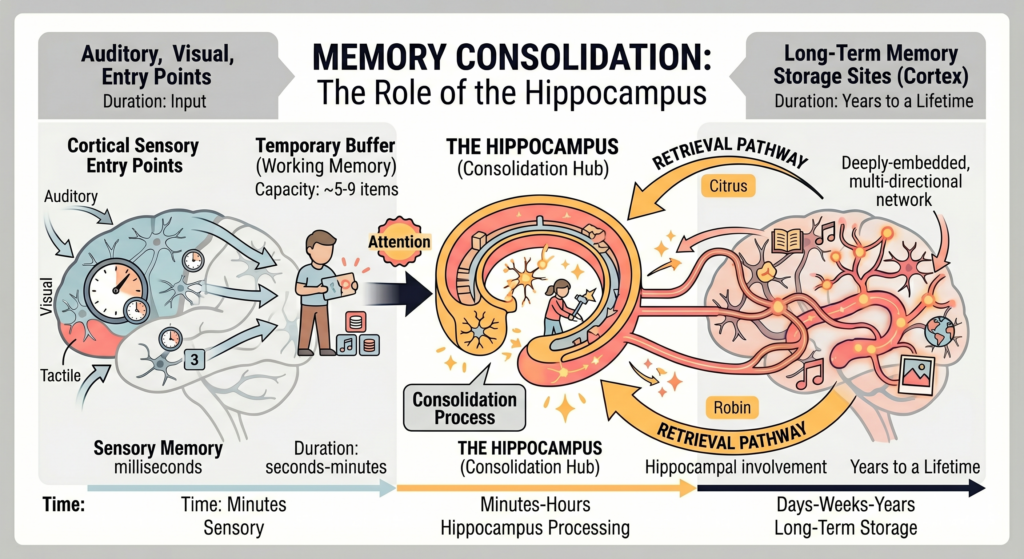
Once information is encoded, it enters short-term (working) memory, a limited-capacity system that holds information temporarily. But without reinforcement, most of this information fades quickly.
To become durable, learning must move into long-term memory.
The conversion of information from short-term (working) memory to long-term memory is a process called memory consolidation. This critical step occurs when newly encoded information, which is initially held temporarily, is reinforced and made durable.
The Hippocampus: The Brain’s Memory Gateway
The hippocampus acts as the brain’s memory gateway, playing a central role in this process. It functions as a processing hub that:
Organizes the newly encoded information.
Links this new data to the learner’s existing knowledge and schemas.
Supports the consolidation of the information into long-term memory.
Crucially, this consolidation does not happen instantly; it unfolds over time and requires review, application, and retrieval to be strengthened. If information is not reinforced (e.g., in “one-and-done” training), it often fails to fully consolidate and remains in short-term recall. Importantly, the hippocampus is also sensitive to stress, fatigue, and overload, common in fast-paced workplace learning.
Why “One-and-Done” Training Fails
When training is delivered as a single event with no reinforcement, information often
Never fully consolidates
Remains context-bound
Fails to transfer to job performance
This is why knowledge checks immediately after training can be misleading.
You see, short-term recall doesn’t equal long-term learning. Besides, learning happens over time, not in a single session.
So, to improve outcomes, training strategies must support the brain’s natural consolidation process.
The Forgetting Curve: Why We Lose What We Learn
In the late 1800s, psychologist Hermann Ebbinghaus identified a pattern that still shapes learning science today: the forgetting curve.
The forgetting curve shows that
Memory retention drops rapidly after initial learning
Most information is forgotten within days without reinforcement
Re-exposure slows the rate of forgetting
This phenomenon, often referred to as forgetting curve psychology, explains why learners may forget up to 70% of new information within 24 hours if nothing reinforces it.
Implications for Corporate Training
For L&D teams, the forgetting curve highlights a critical truth: Just because you completed a training program, it doesn’t mean you became instantly competent in whatever the subject matter was.
If training programs rely on single exposures, whether that would be annual compliance training, one-time workshops, or standalone eLearning modules, knowledge decay is inevitable.
And this is especially problematic when training supports
Safety-critical tasks
Leadership behaviors
Technical or procedural skills
Change management initiatives
Understanding the forgetting curve allows organizations to shift from event-based learning to learning systems designed for sustained retention.
Spaced Repetition: Turning Learning Into Long-Term Memory
One of the most powerful tools for counteracting the forgetting curve is spaced repetition.
What Is Spaced Repetition?
Spaced repetition is a technique that involves revisiting key information at strategically timed intervals rather than all at once.
Each retrieval strengthens neural pathways, making future recall easier. So, instead of cramming, learners
Encounter content multiple times
Apply it in different contexts
Retrieve information from memory
This repeated retrieval is what moves learning from short-term awareness to long-term retention.
Spaced Repetition is a learning technique designed to counteract the forgetting curve by strategically revisiting and retrieving key information at increasing, timed intervals rather than all at once. This deliberate practice strengthens neural pathways and memory consolidation, effectively moving knowledge from short-term awareness into durable long-term retention.
Why Spaced Repetition Works
From a neuroscience perspective, spaced repetition
Reinforces memory consolidation
Strengthens retrieval pathways
Signals importance to the brain
Reduces cognitive overload
Studies consistently show that spaced learning outperforms massed practice for long-term retention.
L&D Application: Designing With Spacing in Mind
Spaced repetition learning can be embedded into training by
Delivering content in short, modular bursts
Scheduling follow-up microlearning touchpoints
Using quizzes and retrieval practice weeks after training
Reinforcing concepts through manager-led discussions
Integrating reminders into performance support tools
Organizations that design with spacing see measurable improvements in learning and memory retention, especially in complex or behavior-based training.
Neuroplasticity and Learning: The Brain Is Built to Change
A common myth in adult learning is that the brain becomes fixed over time. But in reality, the opposite is true.
What Is Neuroplasticity?
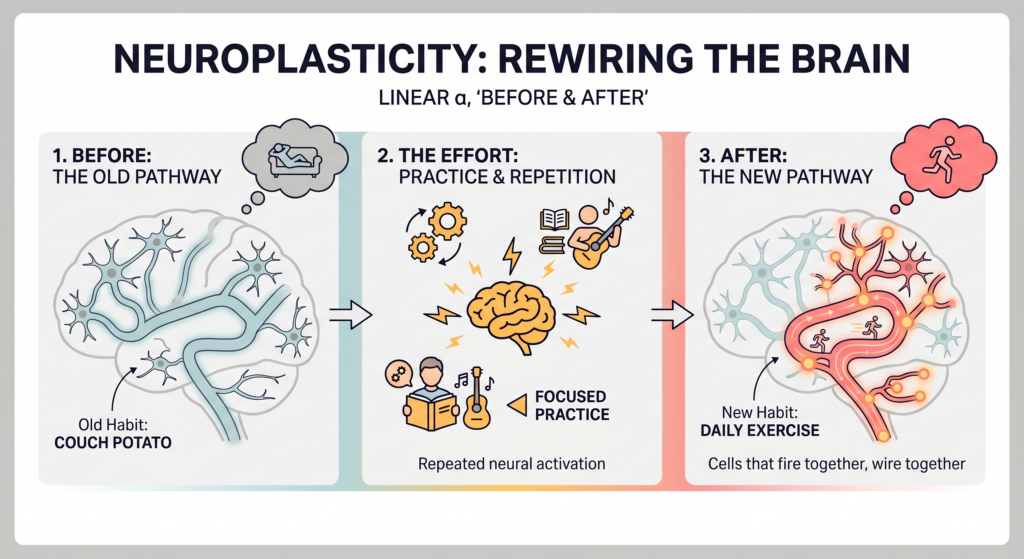
Neuroplasticity refers to the brain’s ability to change its structure and function in response to experience.
So, when people learn
Neural connections strengthen
New pathways form
Frequently used circuits become more efficient
This process continues throughout adulthood and physically reshapes the brain. In other words, every learning experience leaves a biological trace.
Neuroplasticity is the biological mechanism that allows the human brain to continuously reorganize itself by forming new neural connections and refining existing ones in response to learning, practice, and environmental stimuli. This fundamental capability proves the brain is not fixed, but remains adaptable throughout adulthood, making skills development and behavior change possible at any stage of a career.
Why Neuroplasticity Matters for Adult Learners
For corporate environments, this is powerful news because it translates to
Employees being capable of learning at any career stage
Skills being able to be identified and developed
Behavior change being biologically possible with the right design
L&D teams must be aware of neuroplasticity because it mandates a shift from passive content delivery to active, use-based learning. To capitalize on the brain’s ability to change, instructional design must intentionally incorporate active practice, consistent feedback, and real-world application to ensure new neural pathways are established and strengthened.
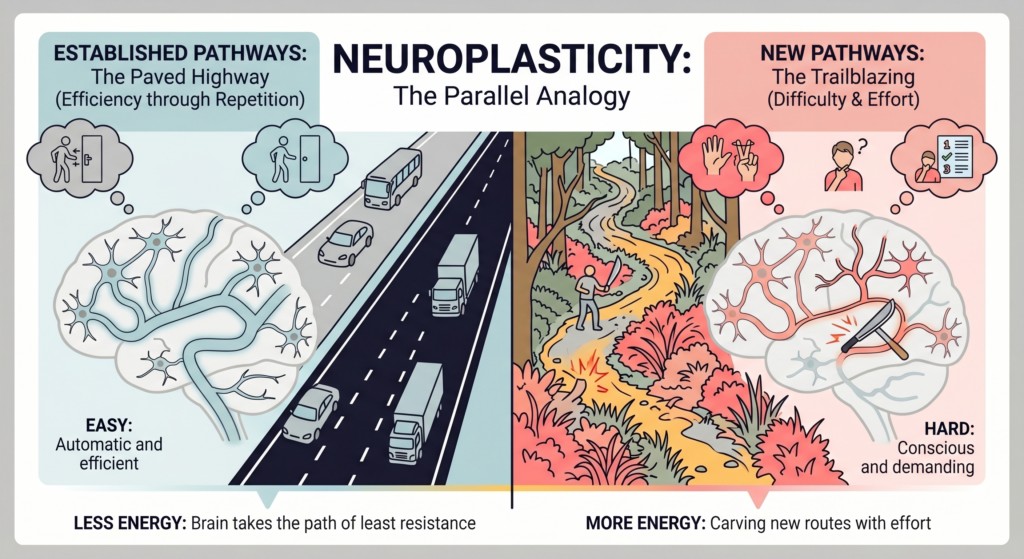
However, neuroplasticity depends on use, which means that if knowledge isn’t practiced or retrieved, neural connections weaken.
Brain-Based Learning Strategies
To support neuroplasticity, learning experiences must include
Active practice
Feedback loops
Real-world application
Reflection and metacognition
Progressive challenge
This is the foundation of instructional design based on neuroscience, which creates experiences that work with the brain.
Applying Learning Science to Instructional Design and L&D
Understanding the cognitive science of learning is only valuable if it translates into better training outcomes. And there are multiple ways for L&D teams to apply memory science in practice.
1. Design for Retrieval, Not Recognition
Recognition, such as re-reading slides, feels easy. But retrieval, or recalling the information without prompts, is what strengthens memory.
That’s the reason why you must use
Scenario-based questions
Practice simulations
Reflection prompts
Knowledge checks spaced over time
2. Prioritize Content Pacing
Overloading learners reduces encoding and consolidation. So, design for
Short, focused modules
Clear learning objectives
Progressive complexity
3. Build Reinforcement Into the Learning Ecosystem
Learning shouldn’t end at course completion. That’s why you must extend learning through
Follow-up microlearning
Job aids and performance support
Manager reinforcement tools
Social learning and discussion
4. Align Learning With Business Context
Memory improves when learning feels relevant. So, it’s important that you connect content to
Real job tasks
Organizational goals
Performance outcomes
Only then will you reap the benefits of a custom learning strategy grounded in neuroscience.
Why Brain-Based Learning Strategy Matters
Many organizations invest heavily in content but not enough in learning design. However, when training aligns with how memory works, organizations see
Higher knowledge retention
Faster skill application
Improved behavior change
Better ROI on training spend
Chances are that you’ve sat through your fair share of training—for better or for worse. In eLearning, it seems like you either remember the five-star, engaging, and impactful experiences or you remember the ones that fell flat, but rarely anything in between. Neurolearning™ design is our secret sauce for creating those memorable-in-the-best-way learning experiences—a way to ensure the highest ROI for your learners. Beyond flashy graphics or a compelling story, it’s linking everything we know about how learners’ brains work to create an experience that engages and inspires.
We call this combination of cognitive considerations our Six Pillars of Neurolearning™ Design:
Make Them Feel
Create an Inclusive Space
Guide Their Experience
Make It Bite-Sized
Make It Relevant
Spark Action
By laying the groundwork for each project, we maximize knowledge transfer and make the most of every eLearning interaction. These six pillars make up the ELM Learning philosophy that has transformed the way our clients think about training. Each pillar is crucial in putting the learner first, reframing content, and inspiring real change and five-star outcomes. Download Our Ebook on Neurolearning™
Luckily, we specialize in designing neuroscience-informed learning experiences that translate science into scalable, engaging, and effective training solutions. To us, learning science is the blueprint. That’s how we help companies build their corporate training programs, such as leadership programs, onboarding journeys, or technical training, to name a few solutions.
Learning That Sticks Is Designed That Way
The science behind learning and memory reveals that forgetting isn’t a learner problem but rather a design problem.
By understanding how encoding works, the role of the hippocampus, the impact of the forgetting curve, the power of spaced repetition, and the potential of neuroplasticity, L&D leaders move beyond content delivery toward true learning transformation.
Remember: When training is designed for the brain, learning lasts longer, and employees perform better.
Want your learning programs to stick? Let’s build them using brain-based design.


