


Ask a product manager how many clear portfolio decisions their team made last month. Most go quiet. Yet those same teams hold weekly status calls, biweekly alignment meetings, and quarterly portfolio reviews. The calendar is full. The decision log is empty.
This is a structural failure: Product development workflows are built around meeting schedules, not decision triggers. Status updates replace strategic decisions. Alignment calls substitute for clear business objectives. Review sessions pile up because the previous review produced no committed outcome.
The fix is not fewer meetings but replacing meeting-dependent workflows with explicit decision points: defined moments where someone makes a binary call and moves the portfolio forward. This is what real product portfolio management looks like.
Why product management teams keep scheduling alignment meetings
Product management teams add meetings when confidence in the process drops.
When strategic objectives are unclear, teams schedule more alignment calls.
When portfolio decisions are deferred, teams add review sessions to track what is still unresolved.
Each new meeting takes time away from the data gathering that actual portfolio decisions require. Teams become busy without becoming decisive. The product portfolio drifts, and no single meeting is responsible.
When product discovery generates an idea without decision gates
Product discovery sessions produce product ideas. That is their stated purpose. Without a structured decision gate at the end, idea volume creates a backlog that the portfolio cannot process.
A typical discovery sprint generates 15 to 30 concepts. Without a scoring framework, most enter a holding queue for months, consuming visibility without receiving investment or being formally closed. Portfolio managers lose track of whether each idea addresses a validated business objective or an untested market assumption.
Discovery needs a gate at the output, not a longer backlog at the start. The gate converts each concept into one of two outcomes: fund to prototype, or document and close. Without this binary, teams cannot make clean portfolio decisions about where to allocate resources.
How status meetings block portfolio decisions
Status updates report what happened. They do not produce commitments about what happens next. A 60-minute weekly update across a 10-person product team consumes more than 500 hours per year. The output is shared awareness, not a portfolio decision that the organization can act on.
Status meetings persist because product portfolio management systems lack defined decision milestones. When no one knows what decision is due next, everyone defaults to sharing progress. Progress-sharing creates the sensation of alignment without the substance.
How broken portfolio governance stalls the strategic portfolio
Portfolio governance determines who decides what, when, and using which data. Most organizations have governance bodies in name but lack decision architecture in practice. Governance meetings review what happened. Decision gates drive what happens next.
Without explicit decision points in the strategic portfolio, two compounding failures emerge.
#1: The missing kill decision in product portfolio management
Most product portfolio management systems track what is active. Few track what should be stopped.
A project running 18 months past its original payback period estimate still consumes engineering hours, product manager attention, and budget. It occupies space in portfolio review conversations. It blocks teams from allocating that capacity to strategic objectives with higher business value.
The kill decision is one of the highest-value moves in portfolio governance. Stopping a misaligned project frees resources to fund a project that delivers clear strategic outcomes against current strategic objectives. Without a kill gate, portfolios accumulate stranded investments. Teams cannot prioritize investments toward new opportunities when existing products keep drawing down limited resources.
#2: Resource drift and the cost of deferred choices
When a portfolio lacks explicit decision points, resources drift toward the most vocal stakeholder, not the highest-value initiative.
Teams allocate engineering capacity based on escalation patterns, not on which strategic initiatives carry the clearest business outcomes. A product roadmap without decision triggers attached to resource allocation decisions is an unconstrained list. Portfolio managers discover mid-cycle that a large share of development capacity sits on projects misaligned with the current strategic direction and business goals.
Reallocating that capacity requires a political process, not a data-driven decision. Organizations operating in competitive markets cannot afford to fund misaligned projects through a full development cycle before discovering they miss strategic objectives.
The 5-gate decision framework for strategic portfolio management
Convert your product development workflow from meeting-driven to decision-driven. Each gate replaces a recurring meeting type with a defined decision event (Exhibit 1). One owner. Clear data requirements. A binary output.
Exhibit 1: The 5-gate decision framework for strategic portfolio management
Five gates produce five committed portfolio decisions per product per development cycle. Most product teams operate with zero to one formal decision points per cycle. Project drift, budget overruns, and missed strategic goals fill that gap.
How to prioritize investments using decision triggers, not calendars
The strongest examples of decision gate discipline come from organizations that built decision-forcing structures into the product development process before meetings could fill the gap.
How Amazon uses decisions as a discovery gate
Amazon’s “Working Backwards” method requires product teams to write a press release and FAQ for a non-existent product before any engineering work begins. If a team cannot write a compelling customer announcement for a product they want to build, the product does not move forward.
This functions as a discovery gate. It turns product ideas into a decision-forcing exercise with a binary output: the press release either makes the case for investment or it exposes gaps in the business logic. No steering committee vote required. The document is the decision.
How P&G applies kill criteria across its product portfolio
P&G’s stage-gate process assigns documented kill criteria to each portfolio review point. Gate reviews require specific data: minimum market size, required margin profile, go-to-market strategy readiness, and alignment to one of P&G’s defined strategic categories.
A product missing two or more criteria at any gate is killed or redirected, regardless of sunk cost. This architecture keeps the product portfolio focused on projects with measurable business objectives. It also prevents the resource drain that occurs when teams continue developing products that no longer fit the current business strategy.
The criteria are set at portfolio planning time, before any gate fires. That distinction removes the political negotiation from the kill decision. When a project reaches the gate, the review is a data comparison, not a debate.
What a product manager needs to run portfolio management decisions
Running the 5-gate framework requires two structural changes:
a decision calendar that replaces the meeting calendar, and
a single source of truth that makes gate data visible without manual compilation.
The 6-week transition from calendar to decision map
Building a single source of truth for portfolio visibility
Decision gates require data available on demand, not data assembled for a meeting. Each gate trigger should pull from a consistent portfolio data layer: budget actuals, milestone status, strategic objective alignment scores, and updated market assumptions.
When a gate fires, the responsible product manager or portfolio manager should access the required data in under 30 minutes. If data assembly takes longer, the process reverts to meeting-based review to compensate. Teams stay focused on decisions when data is always current and always accessible in one place.
A single source of truth is the infrastructure that makes gate decisions fast enough to outcompete meeting inertia.
How ITONICS enables product portfolio management for sustainable growth
Running the 5-gate decision framework at scale requires infrastructure that connects product discovery to strategic portfolio management in one environment.
ITONICS provides the platform to operationalize each gate. Portfolio governance bodies, product managers, and executive teams can evaluate every active initiative against current business objectives without compiling separate reports (Exhibit 2).
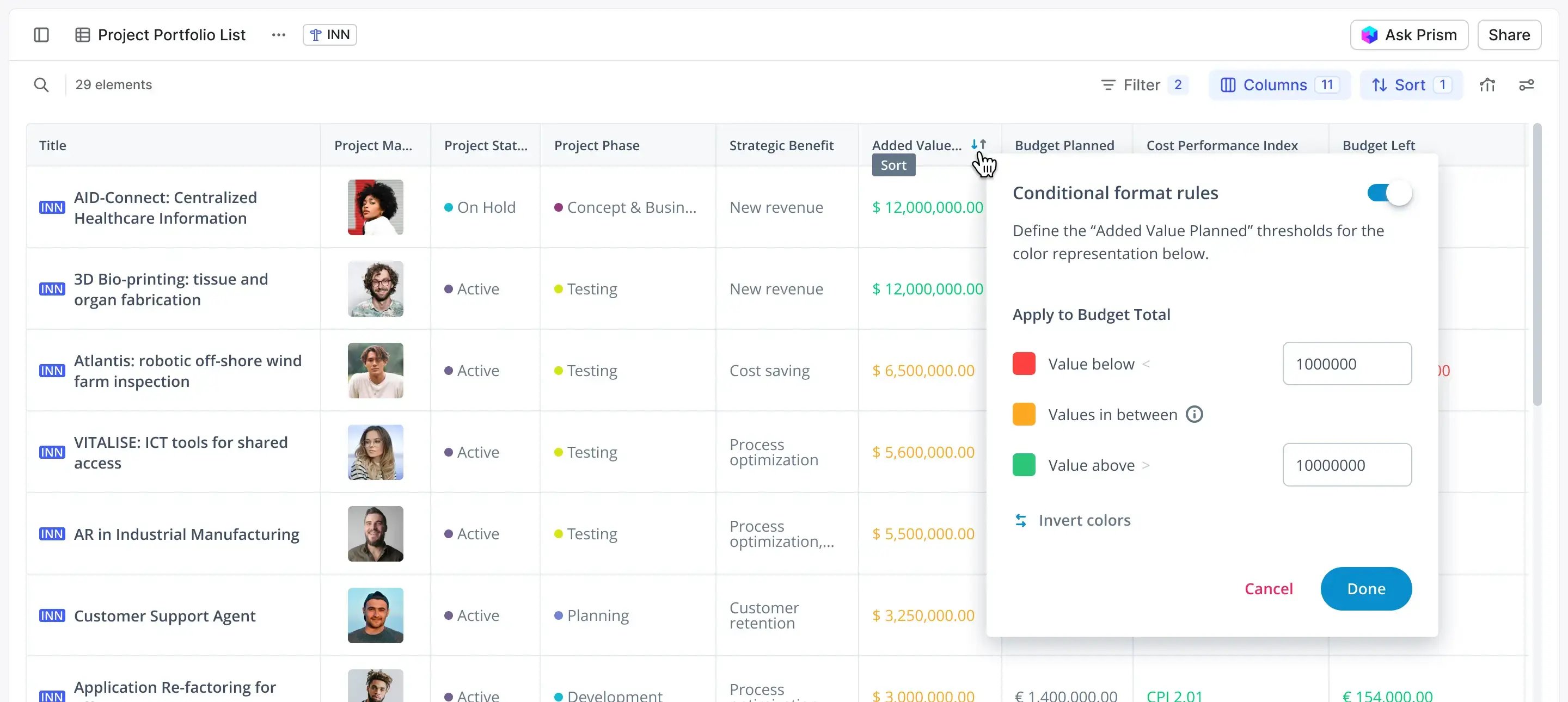
Exhibit 2: Filter, sort, and color-code performance to see what’s on track, what needs attention, and where to act next
For product discovery, ITONICS connects early-stage product ideas to validated strategic goals before they enter the pipeline. This prevents the most expensive failure in product portfolio management: funding a concept that never connected to a business objective. Concepts that fail the Gate 1 criteria are closed with documented reasoning, not silently deferred to a backlog.
For portfolio investment reviews, ITONICS surfaces how each active product maps to current strategic initiatives, what resources it draws, and how it affects portfolio balance across time horizons (Exhibit 3). Portfolio managers gain the clear visibility needed to make smarter decisions at Gate 4 without a full-day data gathering exercise.
/Still%20images/portfolio-audit-trails-and-alerts-2025.webp)
Exhibit 3: Track decisions, updates, and timelines with full audit trails and alerts that keep you in control
Executive teams access portfolio-level visibility into gate completion rates, active investment levels, and strategic objective coverage across the full product portfolio. This replaces the quarterly review meeting with an always-current view that supports sustainable growth decisions without requiring a prepared deck.
The output is a product portfolio management system that allocates resources based on gate decisions, not on who escalated last.


