


A real-world conversation with three corporate innovation practitioners, moderated by Colin Nelson, exploring how innovation leaders can set up 2026 for success.
What if you could plan your entire innovation year in a single session and walk away with clarity on priorities, funding, and execution? In this knowledge session, Colin Nelson (Chief Innovation Consultant, HYPE) hosted an open discussion with two other fellow innovation practitioners who shared how they approach innovation planning in fast-moving, uncertain environments:
Drawing on their experience running and advising innovation programs, the speakers discussed what they would focus on if they were starting an innovation program from scratch at the beginning of the year.
Rather than focusing on theory or frameworks alone, the session explored what actually works when you’re responsible for delivering short-term wins and long-term breakthroughs all at the same time.
Use this summary for a fast read or watch the full recording to dive deeper into the discussion, audience Q&A, and real-world examples.
Why Innovation Planning Fails and What’s at Stake
Many organizations start the year with ambition, but struggle to turn plans into outcomes:
Innovation efforts are scattered, with no clear view of what’s being worked on
Employees are asked for ideas, but don’t see action or follow-through
Leaders rely on lagging metrics and miss early signals of change
Promising opportunities are discovered too late, when the market has already moved
When this happens, innovation loses credibility. Funding becomes harder to secure. Engagement drops. And organizations become reactive instead of proactive.
What’s at stake: Not just innovation performance, but the organization’s ability to adapt, pivot, and protect its future in a fast-moving environment.
The session focused on three foundational capabilities that help innovation leaders avoid these traps and build momentum early in the year.
Three Foundations for a Strong Innovation Year
1. Innovation Portfolio Management (Colin Nelson)
The discussion began with a challenge many organizations recognize:“We’re innovating, but we don’t actually know where our time, money, and capacity are going.”
Without transparency, organizations risk:
Duplicating work across teams
Overinvesting in incremental projects
Missing strategic or long-term opportunities
Struggling to explain innovation value to leadership
The Recommendation:
Create a single source of truth for innovation work, not to control every activity, but to enable transparency and better decision-making.
Key principles discussed:
Use simple, shared categories to create a common language
Track a minimum viable set of innovation data: money in, expected impact, timeline, and risk/quality assessment
Tie funding and capacity decisions to visibility: if a project wants to progress, it needs to be visible
Why it works:When leaders can see the full portfolio, innovation discussions shift from opinion to evidence. Innovation starts to be managed like an investment portfolio, making it easier to balance quick wins with longer-term bets — and to pivot when conditions change.
Key Lesson:Transparency enables better strategy conversations. You don’t lose flexibility — you gain alignment. For more details, you can watch our full on-demand recording of our Mastering Innovation Portfolio Management session.
2. Foster Employee Engagement for Innovation (Jennifer Dunn)
Innovation doesn’t fail because of a lack of ideas, it fails when people stop believing their contribution matters.
Jennifer highlighted a sobering data point from Gallup: global employee engagement fell to 21% in 2024. That means only one in five employees feels fully engaged at work.
In innovation programs, engagement determines whether:
People contribute ideas, insights, and expertise
Teams commit to change and adoption
Innovation efforts scale beyond a central team
What Works in Practice:
Build a consistent engagement cadenceAsk regularly (monthly or quarterly), not occasionally. Consistency builds credibility more than big, flashy campaigns.
Ask better questions, not just for “ideas”
Use different engagement modes depending on the goal:
Close the loop visiblyShare what you heard, what changed, and what happens next. Participation follows credibility.
Example:One organization ran a short “Kill a Stupid Rule” campaign. The biggest win wasn’t the ideas, it was trust. Employees saw leadership act quickly and publicly, creating momentum for more ambitious initiatives later.
Key Lesson:Engagement grows when people see action, not slogans. For more details, you can watch our full on-demand recording of our How to Involve Employees for Faster, More Impactful Innovation Results session.
%20-%20visual%20selection%20(9).png?width=641&height=332&name=5.%20Scaling%20Innovation%20Through%20an%20Internal%20Champion%20Network%20(Polpharma)%20-%20visual%20selection%20(9).png)
3. The 5 levels of market signal listening (Chris Docherty)
The final part of the session focused on how organizations listen to change and why many miss critical shifts until it is too late.
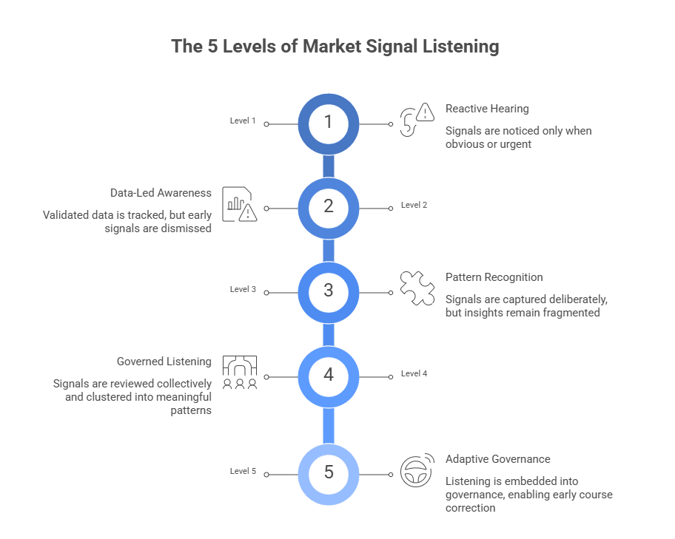
Chris introduced the five levels of market signal listening, emphasizing that listening is not binary. Organizations listen at different depths, and those levels determine how early, or how late, they respond to change.
At the core of his message was a simple reframing:
Listening is governance. If governance determines what gets attention, funding, and action, then how an organization listens to market signals directly shapes its future.
The Five Levels of Market Signal Listening
Level 1 – Reactive HearingSignals are noticed only when they become obvious or urgent. There is no structured approach to capturing or discussing early signals.
Level 2 – Data-Led AwarenessOrganizations track validated data and trends, but early or uncomfortable signals are often dismissed as noise.
Level 3 – Pattern RecognitionSignals are captured more deliberately, but insights remain fragmented. Without synthesis, patterns are difficult to interpret or act upon.
Level 4 – Governed ListeningSignals are reviewed collectively and clustered into meaningful patterns, with governance forums creating space for discussion and challenge.
Level 5 – Adaptive GovernanceListening is embedded into governance. Weak signals, discomfort, and surprise are treated as legitimate strategic inputs, enabling earlier course correction.
Key Lesson:The higher the level of market signal listening, the earlier an organization can adapt. Weak signals matter, because once they are obvious, it is often too late to respond.
How These Three Capabilities Work Together
When combined, these foundations reinforce each other:
A clear innovation portfolio creates transparency and focus
Engaged employees improve idea quality, validation, and execution
Strong listening practices help organizations anticipate change instead of reacting
Together, they help innovation leaders:
Secure funding with confidence
Align innovation with strategy
Move faster with less friction
Build credibility across leadership and the organization
Quick Action Checklist (for Leaders)
Establish a single source of truth for innovation work: Make ongoing initiatives, investments, and capacity visible across teams to support better prioritization and decision-making.
Agree on a small, executive-ready set of portfolio metrics: Focus on clarity over completeness, so leaders can engage meaningfully.
Design engagement around clear objectives, not open idea calls: Use targeted prompts and engagement modes aligned to the outcome you need (problem-solving, discovery, validation, or creation).
Make follow-through visible after every engagement activity: Clearly communicate what was heard, what changed, who owns next steps, and when updates will follow.
Systematically capture and synthesize external signals: Move beyond isolated insights by clustering signals across trends, technology, customer behavior, and regulation.
Embed listening into governance and portfolio discussions: Treat weak signals and uncertainty as strategic inputs, not side conversations.
Want to Go Deeper?
If you’re planning your innovation year and want support with prioritization, portfolio clarity, engagement, or strategic listening, HYPE offers a free consultation and a short Innovation Management Assessment to benchmark maturity and identify prioritized next steps.


