


For decades, space exploration was driven by government budgets, geopolitical rivalry, and national prestige. That era has not disappeared, but it is no longer the full story.
A far more important shift is underway. Space is becoming a commercial domain, and that change is accelerating because of a set of future certainties I would call Hard Trends. These are not guesses. They are measurable, technology-driven shifts that will continue moving forward.
When you understand that distinction, your perspective changes.
You stop asking whether the commercial space economy is real. You start asking how fast it will expand, where the biggest opportunities will emerge, and who will move first.
Why Is the Commercial Space Economy Accelerating Now?

The commercial space economy did not suddenly appear. It reached an inflection point.
Several Hard Trends converged at the same time. Launch costs fell as reusable systems became operational. Satellites became smaller, smarter, and less expensive. Demand for communications, navigation, imaging, and Earth observation kept rising.
Whenever capability improves while cost declines and demand rises, acceleration follows. We have seen that pattern before in computing power, bandwidth, and digital storage. Space is now following the same path.
This is why I do not view today’s momentum as hype. I view it as a predictable outcome of converging certainties.
When the underlying capability curve shifts, the future changes with it.
How Did Reusable Launch Change the Game?
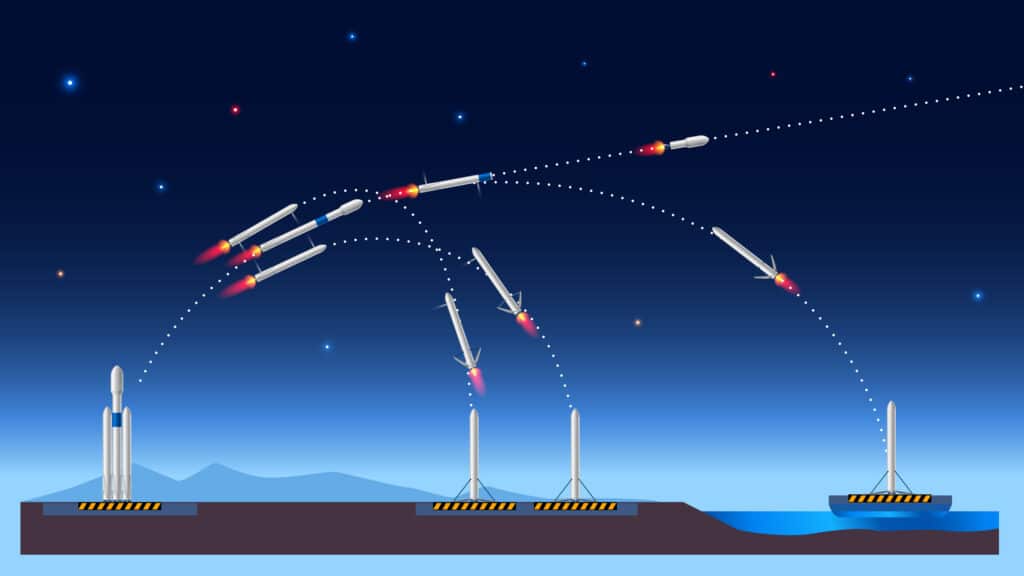
For a long time, access to space was rare, expensive, and slow. This is no longer true.
Commercial launch providers changed the economics of orbit by making launches more frequent, more reliable, and far more cost-effective. Reusability did more than reduce expense. It changed behavior. It allowed companies to think in terms of iteration, deployment cycles, and faster improvement. That is the real breakthrough.
When access becomes repeatable, innovation accelerates. New players can participate. Existing operators can replace aging systems faster. Researchers can test ideas without waiting years for a window.
Here is what lower launch friction made possible:
More frequent deployment of satellites
Faster replacement and upgrading of orbital systems
Lower barriers for research, defense, and commercial experimentation
This is not just a space rocket story. It is a market-creation story.
Why Are Satellites Becoming Essential Infrastructure?

Most people still think of space as something in the distance. In reality, space is already embedded in daily life.
Satellites support GPS, weather forecasting, shipping logistics, emergency response, agriculture, financial timing, telecommunications, and environmental monitoring. These are not niche technologies. They are part of the hidden infrastructure that modern day society depends on.
What is changing now is scale. Satellite constellations are expanding. Coverage is improving. Data is becoming more precise and more immediate. As a result, businesses and governments can make better decisions faster.
This is one of the clearest signs that space is moving from aspiration to infrastructure.
The more connected our world becomes, the more valuable space-based intelligence becomes.
Why Does Low-Earth Orbit Need Commercial Platforms?

Low-Earth orbit has long been shaped by government-led platforms and now that model is evolving.
Public agencies increasingly want to direct more resources toward deep-space exploration while enabling private operators to build and run platforms closer to Earth. That shift is both logical and predictable.
We have seen this before in other industries. Government helps pioneer capability. Private enterprise scales it, diversifies it, and builds new business models around it.
Commercial space stations and orbital platforms are now being designed for research, manufacturing, biotech, materials science, and private-sector operations. That is a major transition because it turns orbit into an economic environment rather than a limited public program.
This is how industries mature.
Why Is the Moon a Practical Next Step?

The Moon is returning to the center of planning, but this time in a more practical way. It is not just a symbol. It is a proving ground.
Organizations are treating the Moon as a place to test systems, validate technologies, and build operational experience beyond Earth. Before long-duration expansion comes real capability. Before scale comes learning. That makes the Moon strategically valuable.
Current lunar efforts are focused on three practical areas:
Scientific research
Technology validation
Infrastructure testing in extreme environments
This is the right sequence. You do not build a sustainable off-world future by starting with fantasy. You build it by increasing capability step by step, using environments that teach you what works and what fails.
What Does In-Orbit Servicing Tell Us About the Future?

One of the strongest indicators of a true commercial transition is the rise of in-orbit servicing.
When assets are expensive and important, replacing them every time is inefficient. Over time, maintenance becomes inevitable. That is now beginning to happen in space.
Satellite servicing, robotic assistance, life extension, and refueling are no longer theoretical concepts. They are early-stage realities. That is significant because it marks a deeper shift in thinking.
Space assets are starting to be treated as long-term investments rather than disposable tools. Once that mindset takes hold, new markets form around repair, upgrade, maintenance, logistics, and assembly.
That is how an ecosystem develops.
Why Is This a Global Hard Trend?
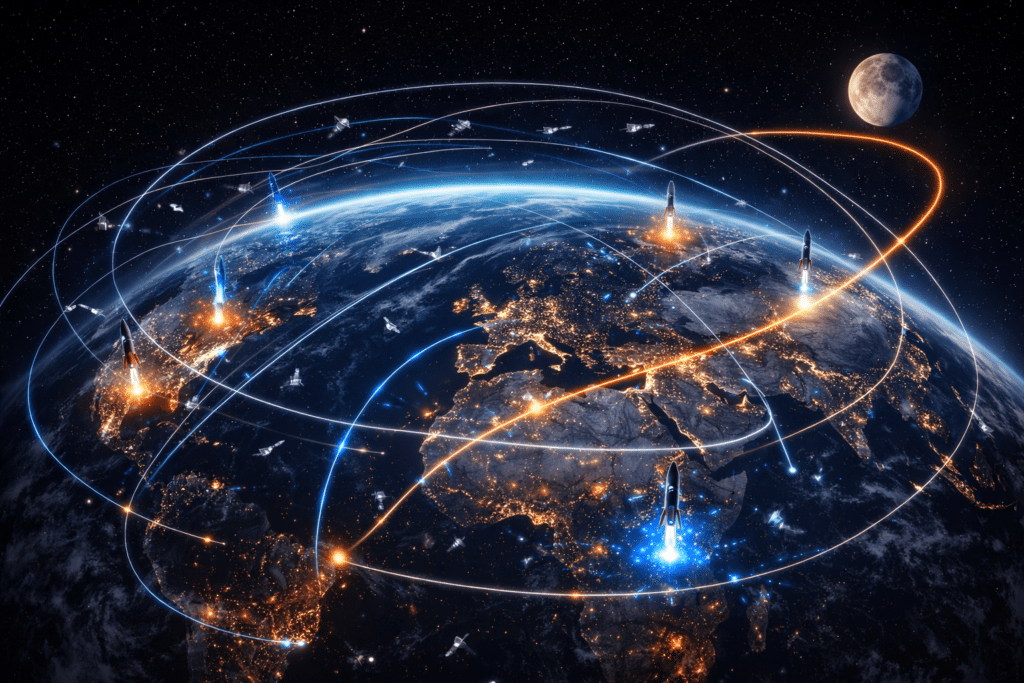
The move toward commercial space is not limited to one company or one nation.
Different countries have different priorities, but they are responding to the same certainties. Lower launch costs, stronger satellite capability, rising demand for orbital services, and growing geopolitical relevance are affecting everyone.
That is why this is bigger than a competitive race. It is a global Hard Trend.
Europe continues advancing launch and observation capabilities. China has built its own orbital presence. India has demonstrated efficient launch and lunar capability. The United States remains a major commercial driver. Others will continue to expand their role as the economic relevance of space grows.
When multiple regions move in the same direction for the same underlying reasons, you are not looking at a fad. You are looking at a future fact.
Why Isn’t This Just Another Space Bubble?
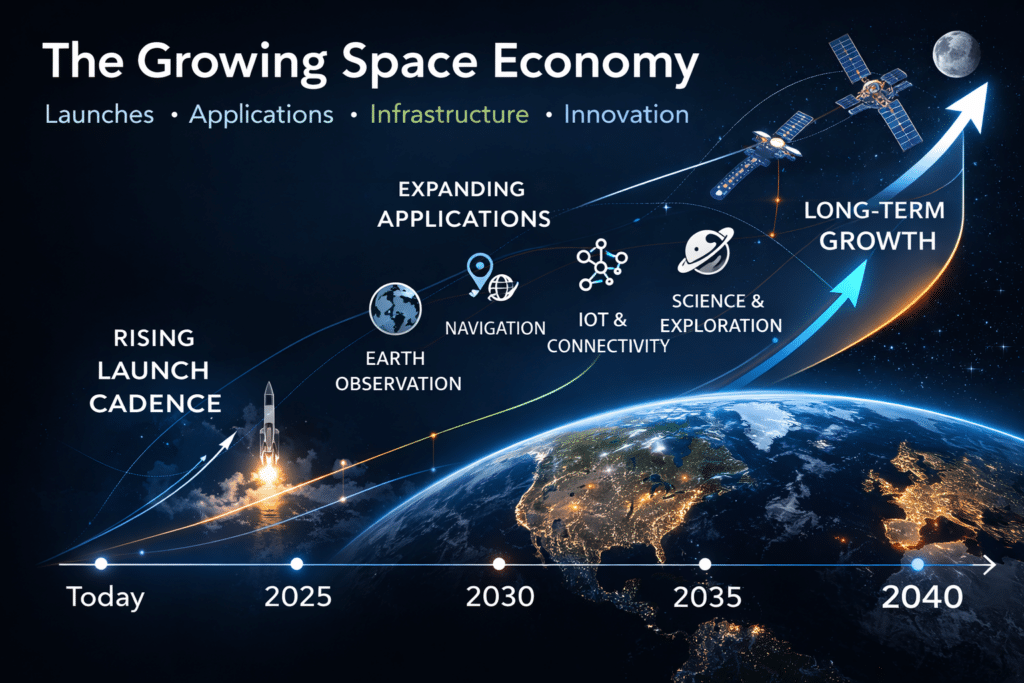
Not every company in the space sector will succeed, that is normal in any growing market.
But it would be a mistake to confuse company-level volatility with weakness in the larger direction. The commercial space economy is being built on durable foundations. Access costs are down, demand is up, technical capability is proven, and Governments remain involved as customers, regulators, and strategic participants.
These trends build on each other, creating a lot of excitement before there is real, lasting value.
Space is different now. It already delivers lasting value in communications, navigation, intelligence, logistics, agriculture, climate analysis, and national security.
That is why the smarter question is not whether the commercial space economy is real.
The smarter question is which layer of the value chain will create the biggest advantage next.
Why Should Business Leaders Pay Attention Now?

Space is no longer a distant category that only aerospace leaders need to understand. It is becoming part of the operating environment for every industry.
If you rely on communications, logistics, mapping, risk analysis, environmental data, supply chain visibility, or real-time monitoring, you are already being affected by the commercial space economy. The influence may be indirect today, but it will become more visible with time.
This is where Anticipatory leadership matters most.
Reactive leaders wait until disruption is obvious. Anticipatory leaders identify the Hard Trends in advance, pre-solve predictable problems, and position themselves early. That is how you turn disruption into advantage.
The future of space is not just about exploring beyond Earth. It is about building powerful new infrastructure that creates value on Earth.
What Bold Move Should You Make Next?

The commercial frontier is no longer theoretical. It is opening now.
Reusable launch, expanding satellite infrastructure, commercial platforms in orbit, lunar testing, and in-orbit servicing are all signals of the same shift. Space is moving from government-led exploration to scalable commercial capability.
That means the opportunity is no longer reserved for a handful of aerospace companies.
The real opportunity belongs to leaders who can recognize certainty early, connect it to business strategy, and act before competitors do.
The future does not need to surprise you.
When you start with certainty, you can anticipate change, pre-solve problems, and make bold moves with far lower risk. That is the real lesson of the commercial space frontier, and it is why the biggest opportunities are still ahead.
Why Wait for the Future When You Can Anticipate It?

The commercial space economy makes one thing clear: the biggest opportunities do not belong to those who react first. They belong to those who anticipate first.
This is the mindset Daniel Burrus has championed for years: identify the Hard Trends that will happen, use them to pre-solve problems, and make your bold moves before the window narrows. In a world where disruption is accelerating, that approach is no longer optional. It is a competitive advantage.
To learn more about Daniel Burrus’s keynotes and how they help organizations harness certainty, accelerate innovation, and lead change with confidence, visit www.burrus.com.


