

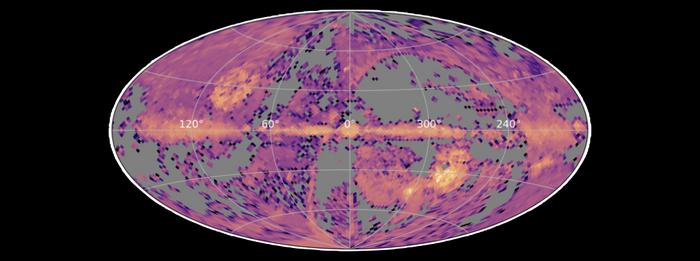
Credit Image Credit: SDSS-V, Ilija Medan, University of Toronto
The Sloan Digital Sky Survey V has launched Data Release 20, expanding the Milky Way Mapper survey across both hemispheres
Utilising twin spectrographs, the dataset delivers over two million total spectra, constructing a detailed map of stars in and around the galaxy.
Galactic archaeology in the outer halo
The release introduces the first public dataset from the Milky Way Mapper Halo Program, which maps the faint stellar shroud surrounding the galactic disk. Featuring spectra from 250,000 halo stars, the dataset covers giant stars reaching 65,000 light-years away, fast-moving local stars, and ancient cosmic relics.
Targeted searches for ultra-metal-poor stars containing less than 1% of the Sun’s iron levels have already led to the discovery of the most pristine star known in the universe. Mapping these chemical signatures and orbital dynamics helps astronomers reconstruct the Milky Way’s early formation and past mergers with satellite galaxies.
Expanding the census of dead stars
Data Release 20 more than doubles the public catalogue of white dwarf spectra from the survey, adding 49,000 newly observed stellar remnants.
Over 80% of these dead stars are new to the survey, with more than 40% located in the Southern Hemisphere.
These spectra preserve records of stellar evolution, while chemical signatures in their atmospheres often reveal the debris of shredded planetary systems that survived the death of their host stars.
Mapping local neighbourhoods and stellar birthplaces
Closer to Earth, the Solar Neighbourhood Census provides spectra for 280,000 nearby stars within 300 light-years of the Sun.
By pairing this spectroscopy with distance measurements from the European Space Agency’s Gaia satellite, researchers are establishing a benchmark dataset focused on low-mass M dwarfs and brown dwarfs.
In addition, the Young Galaxy Program quadrupled in scale to cover 200,000 young stars, planet-forming nurseries, and massive OB stars that define the galaxy’s spiral arms.
High-energy cross-matching and extragalactic relics
Through a collaboration with the eROSITA X-ray space telescope, the survey gathered nearly 48,000 optical spectra matching high-energy X-ray sources with physical stars, creating the largest joint optical and X-ray catalogue assembled to date. Meanwhile, research utilising the new release identified the first five carbon-enhanced metal-poor stars in the Large Magellanic Cloud.
This discovery confirms that ultra-ancient stellar fossils exist in smaller neighbouring galaxies, challenging previous assumptions about fundamental chemical differences between the oldest stars across different galaxies.


