


Lessons in Resilience and Radical Creativity
LAST UPDATED: March 17, 2026 at 3:17 AM
by Braden Kelley and Art Inteligencia
Beyond the Luck of the Irish: A Strategic Foundation
St. Patrick’s Day often arrives draped in the superficial — green beer, plastic shamrocks, and the persistent myth of “the luck of the Irish.” But for those of us navigating the complex waters of human-centered change and innovation, there is a much deeper well to draw from than mere fortune.
In the world of digital transformation, “luck” is rarely a random lightning strike. Instead, it is the byproduct of a culture that is perpetually prepared for opportunity — a fundamental tenet of any robust innovation strategy. Ireland’s history serves as a definitive masterclass in stoking the innovation bonfire. It is a narrative defined by the ability to pivot in the face of existential adversity, using communal resilience as a primary engine for growth.
The Modern Creative Landscape
Today, Ireland occupies a unique global position. It sits at the intersection of ancient, soulful arts and the cutting-edge rigors of the modern tech sector. This isn’t a coincidence; it’s the result of a national identity that values intellectual agility. Whether it is a rural community re-imagining its local economy or a Dublin-based tech giant scaling a new framework, the underlying pulse remains the same: a blend of high-tech capability and high-touch humanity.
The Thesis: A Survival Mechanism
The core takeaway for change leaders is this: Irish creativity is not just about aesthetic output or poetic flair. It is a survival mechanism. It is rooted in three distinct pillars that every modern organization needs to thrive:
Resilience: The emotional and structural capacity to endure “The Great Contraction” and emerge with a new value proposition.
Narrative: The use of storytelling to bridge the gap between technical change and human adoption.
Connection: Prioritizing the “Human-Centered” element of innovation to ensure that technology serves autonomy rather than eroding it.
By examining these cultural traits, we can move beyond the holiday tropes and uncover practical lessons for building organizational agility and fostering a culture where radical creativity is the standard, not the exception.
The Power of the “Sennachie”: Narrative as a Strategic Framework
In the ancient Irish tradition, the Sennachie (pronounced shan-a-key) was much more than a simple storyteller. They were the custodians of history, the keepers of genealogy, and the navigators of local law. In modern organizational terms, the Sennachie was the ultimate Chief Experience Officer — ensuring that every member of the community understood their place within the collective narrative.
When we look at digital transformation or complex human-centered change, the technical hurdles are rarely what cause a project to fail. It is the narrative vacuum. Without a compelling story, employees fill that silence with anxiety, resistance, and skepticism. The Irish tradition teaches us that the story is not an “add-on” to the strategy; the story is the strategy.
Narrative as an Alignment Tool
A well-crafted narrative serves as a North Star for distributed innovation teams. It provides the “Why” that bridges the gap between a high-level vision and daily execution. In Ireland, stories were used to maintain identity through centuries of upheaval. In business, we use narrative to:
Socialize Innovation: Moving an idea from a slide deck to the “water cooler” conversation requires a narrative that resonates on a human level.
Build Empathy: By focusing on the “Characters” (our customers and employees) rather than just the “Features,” we ensure the solution actually solves a human pain point.
Overcome Organizational Resistance: A story that honors the past while pointing toward a necessary future reduces the “immune system” response of the corporate culture.
Application: The “Great Story” Framework
To apply this Irish wisdom to your next project, stop writing technical requirements and start drafting the “Great Story” of the change. This involves moving beyond content and focusing on context. Who are the heroes of this transformation? What is the “villain” (e.g., inefficiency, poor customer experience, or technical debt)? And most importantly, what does the “happily ever after” look like for the individual contributor?
By adopting the mindset of the Sennachie, leaders can move away from “managing” change and toward stoking the imagination of their teams. When people can see themselves in the story, they don’t just participate in the change — they own it.
Constraint-Based Innovation: Creating from Scarcity
One of the most profound lessons we can learn from the Irish experience is the art of innovation under pressure. For centuries, Ireland was defined by geographical isolation and limited natural resources. Yet, rather than stifling progress, these boundaries acted as a crucible for radical resourcefulness. In the world of FutureHacking™, we recognize that unlimited budgets often lead to bloated, unfocused projects, while tight constraints force a team to identify the most elegant, high-impact solutions.
Ireland’s modern transformation into a global “Silicon Isle” wasn’t fueled by an abundance of coal or iron, but by the strategic cultivation of its only infinite resource: intellectual and imaginative capital. This shift from an agrarian society to a digital leader is a prime example of how an “island mentality” — the recognition of finite boundaries — can drive a culture to seek out-sized returns through pure ingenuity.
The “Scarcity Mindset” vs. “Abundance Thinking”
In organizational change, we often hear “we don’t have the budget” or “we don’t have the headcount” as excuses for stagnation. The Irish model suggests a flip in perspective. Scarcity isn’t a wall; it’s a design constraint. When we look at innovation through this lens, we begin to:
Prioritize the Essential: Without the luxury of waste, every move must contribute directly to the Customer Experience (CX).
Leverage Hidden Assets: Like the Irish turning humble ingredients into world-renowned exports, organizations must look at their existing data, talent, and “dark” assets to create new value.
Encourage Radical Collaboration: When resources are low, the only way to scale is through partnership and shared ecosystems.
Application: Innovation as a Survival Skill
To apply this to your own innovation bonfire, start by viewing your current constraints as the parameters of a creative challenge. If you had 50% less time or 80% less budget, what is the one thing that must still work? That “one thing” is your core value proposition.
By embracing the Irish spirit of “making do” and then “making better,” leaders can foster a culture that doesn’t fear limitations but uses them as a springboard for organizational agility. True innovation isn’t about having the most; it’s about doing the most with what you have.
The “Meitheal” Mentality: Radical Collaboration and Ecosystem Thinking
In the heart of Irish rural tradition lies the concept of the Meitheal (pronounced meh-hel). It describes a group of neighbors coming together to help one another with the harvest or other labor-intensive tasks. There was no formal contract, only the understood social capital of mutual support. If one farmer’s crop was at risk, the community became the safety net.
In modern digital transformation, we often suffer from “Silo Syndrome” — where departments guard their resources and data as if they were private fiefdoms. The Meitheal mentality offers a powerful antidote. It shifts the focus from “Hero Innovation” (the lone genius) to “Community Innovation,” where the collective intelligence of the organization is harvested for the benefit of the Customer Experience (CX).
Breaking the Silos: From Hierarchy to Community
To build a truly agile organization, we must move beyond rigid reporting lines and toward fluid, purpose-driven clusters. When we apply the Meitheal spirit to a Modern Experience Management Office (XMO), we see:
Shared Burden, Shared Success: When a project hits a bottleneck, resources from other “neighboring” departments flow toward the problem without the need for bureaucratic escalation.
Cross-Functional Agility: The ability to assemble “Tiger Teams” that possess diverse skill sets — designers, developers, and strategists — all focused on a single harvest: the project’s completion.
Mutual Accountability: In a Meitheal, you help today because you might need help tomorrow. This creates a culture of psychological safety and long-term trust.
Application: Harvesting the Collective Intelligence
How do you “socialize” the Meitheal in a corporate environment? Start by identifying the “shared harvests” in your organization. These are the goals that no single department can achieve alone — such as improving the **End-to-End User Journey**.
By fostering a culture where helping a colleague is seen as a strategic contribution rather than a distraction from one’s “real job,” leaders can stoke the innovation bonfire across the entire enterprise. Radical collaboration isn’t just a buzzword; it’s the ancient Irish secret to doing more together than we ever could apart.
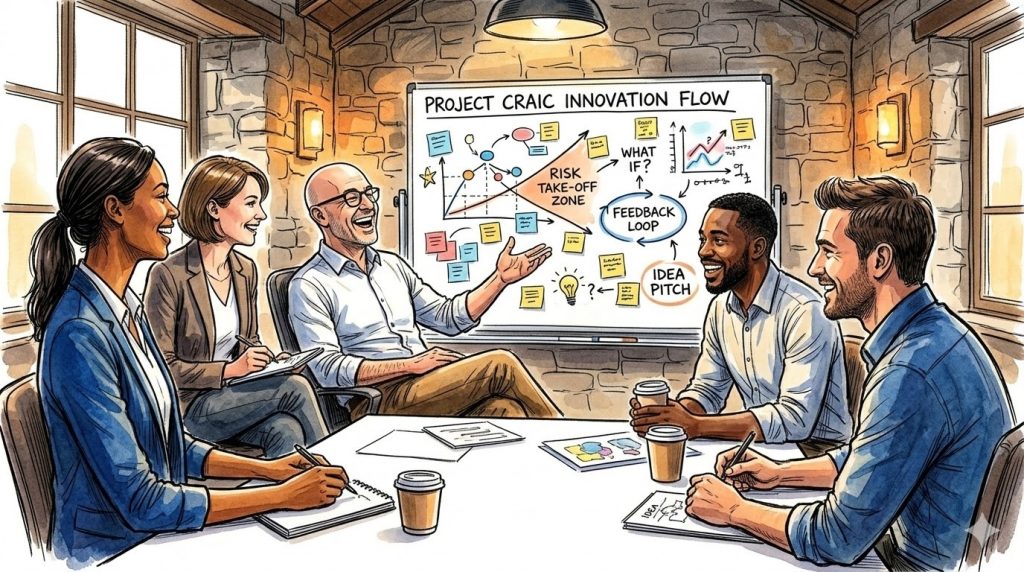
Comfortable with the “Craic”: The Role of Play in High-Stakes Innovation
In Irish culture, “The Craic” (pronounced crack) is often misunderstood by outsiders as mere small talk or revelry. In reality, it is a sophisticated form of social intelligence. It encompasses news, gossip, entertainment, and, most importantly, sharp-witted conversation. For an innovation leader, the “Craic” represents the ultimate expression of psychological safety — an environment where ideas can be batted around, deconstructed, and reimagined without the fear of corporate reprisal.
When we look at the Experience Level Measures (XLMs) of high-performing teams, one of the leading indicators of success is the frequency of informal, playful interaction. If your team is too afraid to joke, they are likely too afraid to take the risks necessary for a “FutureHacking™” breakthrough.
Wit as a Navigation Tool for Complexity
The Irish use wit not just for humor, but as a way to navigate Moral Uncertainty and complex social dynamics. In a business context, a culture that embraces the “Craic” benefits from:
Reduced Friction: Humor is a lubricant for change. It allows teams to acknowledge the absurdity of a difficult situation while still moving toward a solution.
Rapid Prototyping of Ideas: In a playful environment, “What if?” becomes a natural part of the conversation rather than a formal exercise.
Resilience Against Burnout: The ability to find joy in the process — especially during a grueling digital transformation — is what keeps the “innovation bonfire” burning long after the initial excitement has faded.
Application: Creating a “Low-Anxiety” Innovation Zone
To apply this, leaders must model vulnerability and playfulness. This doesn’t mean forced fun or “mandatory happy hours.” It means creating a culture where quick thinking and diverse perspectives are celebrated. It’s about building a space where the “High-Anxiety” personas in your organization feel safe enough to contribute their “Digital Skeptic” viewpoints without being shut down.
When your team is comfortable with the “Craic,” they aren’t just working; they are engaging in a communal creative act. Innovation is serious business, but it shouldn’t be somber. By injecting a bit of the Irish spirit into your workflows, you transform a workplace into an Innovation Ecosystem where the best ideas can finally breathe.
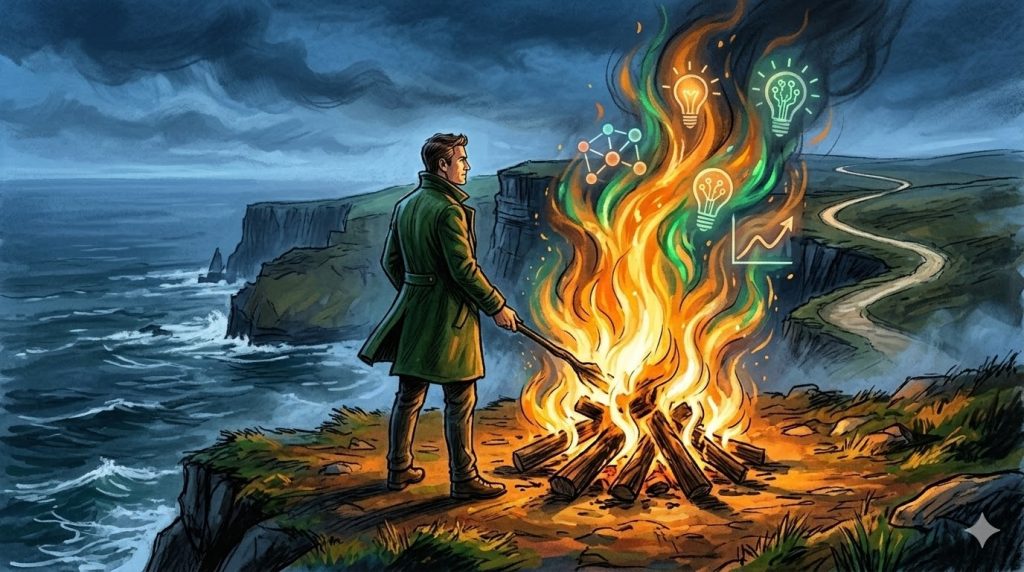
Conclusion: Stoking Your Own Creative Bonfire
As we’ve explored, the “Luck of the Irish” is a misnomer for what is actually a disciplined, culturally ingrained approach to resilience and radical creativity. From the narrative mastery of the Sennachie to the communal strength of the Meitheal, the lessons from Ireland provide a robust blueprint for any leader navigating the complexities of human-centered innovation.
In the world of digital transformation, we often get blinded by the “shiny objects” — the latest AI tools or software platforms. But the Irish spirit reminds us that innovation is 10% technology and 90% people. The “Pot of Gold” at the end of the change management rainbow isn’t a finished product; it is a sustainable, agile culture that is capable of reinventing itself time and again.
The Call to Action: Adopt a “FutureHacking™” Mindset
To bring these lessons into your own organization, don’t just celebrate the holiday — integrate its principles:
Tell the Story: Stop issuing mandates and start building a narrative where your employees are the protagonists.
Embrace the “Craic”: Lower the anxiety in your innovation zones to allow for the kind of playful friction that sparks truly original ideas.
Focus on the Human Experience: Use Experience Level Measures (XLMs) to ensure your “innovations” are actually improving the lives of your customers and staff.
Creativity is a renewable resource, but it requires a hearth. By fostering a environment that values storytelling, collaboration, and resourcefulness, you aren’t just managing a project; you are stoking an innovation bonfire that will light the way through even the most uncertain economic shifts.
This St. Patrick’s Day, let’s look beyond the shamrocks and recognize that our greatest creative assets are already sitting right in front of us: our people, our stories, and our shared commitment to making tomorrow better than today.
Image credits: Google Gemini
Content Authenticity Statement: The topic area, key elements to focus on, etc. were decisions made by Braden Kelley, with a little help from Gemini to clean up the article and add citations.
 Sign up here to get Human-Centered Change & Innovation Weekly delivered to your inbox every week.


